The Leyden jar
If electricity is a fluid, you ought to be able to bottle it. That is the plain idea two men had, each on his own, in the winter of 1745-1746. Glass holds electricity back, Gray had shown as much, so a glass flask should keep it the way it keeps water. How people came to believe in that fluid, from amber to Gray’s string, is the earlier story, the one that ends with Franklin. This one begins in a small town in Pomerania, near the Baltic.
On 11 October 1745, in Cammin, Ewald Georg von Kleist, dean of the cathedral chapter, takes a small medicine phial, pours in a little alcohol or mercury and pushes a nail through the cork down into the liquid. He holds the phial in one hand and brings the nail to a friction machine. Then he touches the nail with his other hand. The shock runs through his arm and shoulder. He writes to a few scholars in Berlin and elsewhere, but his account is muddled, and those who try get nothing. They stand the phial on a table instead of holding it. Kleist had in fact noticed that the effect comes only in the hand, but without understanding why, and his recipe dwells on something else, a phial well dried and warm.
A few weeks later, in Leyden, in Holland, the same idea is going round the laboratory of Pieter van Musschenbroek, professor of physics at the university. It is a visitor, Andreas Cunaeus, a lawyer with a passion for experiments, who takes the first blow, at home, holding in his hand a glass of water with a wire from the machine dipped into it. He holds it in his hand because he does not know there is another way. Musschenbroek repeats the experiment in January 1746 and takes the blow in turn, full in the body.
On 20 January 1746, he writes to Réaumur, in Paris. He describes the glass in his right hand, his left hand reaching for the conductor, and the blow that strikes him in the arms and chest. He thought his last hour had come. He adds, in a free translation, "you could offer me the kingdom of France and I would not take such a blow again". Réaumur passes the letter to the abbé Nollet, who reads it to the Academy of Sciences. Within weeks, all of learned Europe wants to feel the Leyden shock.
Nollet gives the flask the name it still bears, the Leyden jar, and he makes a show of it. In the spring of 1746, at Versailles, before Louis XV, he sends the discharge of a single jar through a hundred and eighty guards holding hands, and the whole company jumps at once. He does it again at the Carthusian monastery in Paris, along a line of monks joined one to the next by iron wires, more than a mile long. The jump is simultaneous from one end of the line to the other, and no one can measure the time the shock takes to pass.
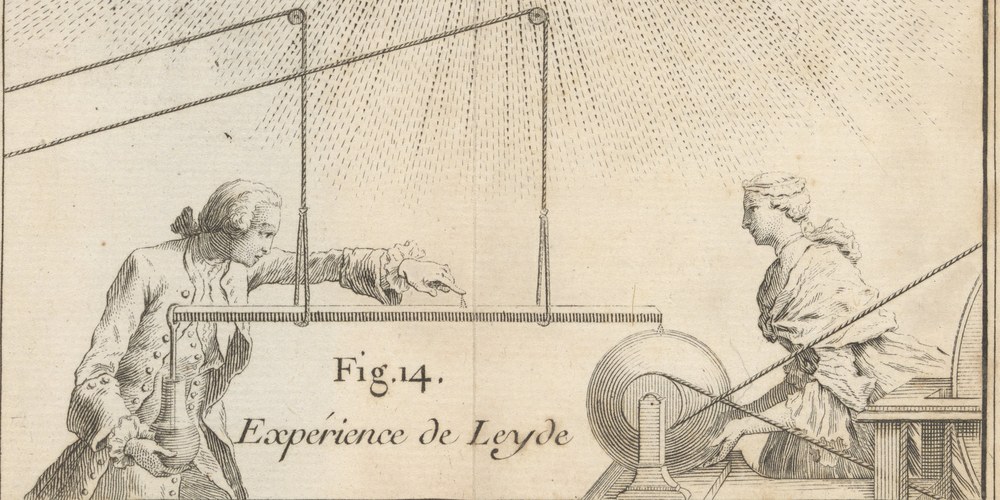
What set Kleist, who felt the shock, apart from his correspondents, who felt nothing, was the hand. Water inside, the hand outside, and between them a thin wall of glass that lets nothing through. The machine charges the water, and the hand wrapped round the glass takes on, from the other side, what answers it. Set on a dry wooden table, the jar has no such second face, and it hardly charges at all. People soon understand that the hand can be replaced by metal foil pasted on the glass, then the water by another foil on the inside. The Leyden jar takes the shape you see in museums, a jar dressed in metal inside and out, a rod coming up through the stopper.
Franklin receives it with the rest, in 1747, and explains it with his single fluid. When the jar is charged, he says, exactly as much fluid goes into the inner face as comes out of the outer one. One side has too much, the other too little, and by the same amount. That is why a jar whose outer face is insulated refuses to charge, since nothing can leave it. When the two faces are joined by a wire, or by a human body, the surplus runs to the shortage, and nothing is left. The two charges cancel. Franklin’s plus and minus, which lesson 1.1 tells about, found their best proof in this jar.
It remained to find where the charge lives. Everyone thinks it is in the water, since the water is what gets electrified. Franklin checks in 1748. He charges a jar, pours its water into another bottle, and the second gives no shock. He fills the first with fresh water, and it still shocks. He tries again with a pane of glass between two lead plates, which he lifts off, touches and puts back; the pane alone keeps the charge, he concludes. Metal and water, in his view, only bring the charge to the glass and take it away again. Classrooms repeat this experiment today with a dissectible jar, whose two metal cups are taken off and put back, and the shock is still there. We now know that Franklin’s conclusion does not hold for an ordinary capacitor. The charge sits on the plates, and the glass only becomes polarized; if the dissectible jar keeps its shock, it is because, when it is taken apart at high voltage, small discharges at the rims of the cups leave the charge on the surface of the glass.
In a letter dated 1748 and signed in April 1749, Franklin describes eleven of these lead-covered panes, joined together to give a stronger shock. He calls the assembly an "electrical battery", as one speaks of a battery of cannon, guns that fire together. The word stuck. It passed to cells grouped together, then to the car battery and the tool pack, which no longer hold their charge the way a jar does.
That leaves the name of the thing itself. In 1782, Alessandro Volta describes an instrument made to reveal the faintest electricity, two metal discs separated by a thin insulating layer. A small charge is gathered slowly, then one disc is lifted away, and the charge shows itself. Volta calls it condensatore, because it is thought to condense the electric fluid there, making it denser than a lone conductor could. English said condenser for a century and a half, and the word lingers in old radios and car ignitions; capacitor, which speaks of how much the thing can hold, took over in the twentieth century. The fluid has left the books; the old name, condenser, was given by those who thought they were condensing a fluid.
On the bench, its principle has not changed. Kuphaldt, in chapter 13 of his first volume, describes it as two conductors, the plates, separated by an insulator. It is the jar, flattened and rolled up. The charge put into it is a quantity you store and give back, and it always divides into a plus on one plate and an equal minus on the other. It comes back all at once when the two faces are joined. That is why you discharge the big capacitors of a power supply or an amplifier before putting your fingers in, and Musschenbroek, better than anyone, could have written it.
What next?
- Electricity before Franklin. From amber to Gray’s string, how people came to believe in a fluid that one might want to bottle.
- Lesson 1.1, Charge and its motion. Franklin’s plus and minus become charge and conventional flow, and the electron arrives in 1897.
- The capacitor. The lesson to come measures what the jar holds, and gives its capacity a unit, the farad.
Electricity before Franklin
Before it was something you measure, electricity was a parlour curiosity for two thousand years.
storyFranklin’s fluid
A multimeter in series shows a number with a sign, and the sign depends on which lead you put on which side.
storyGalvani’s frog
The pack of a cordless drill shows 3.7 V cells.
the crossroads1.1 Charge and its movement
Everything tied to this idea, and the exercises.