Electricity before Franklin
Before it was something you measure, electricity was a parlour curiosity for two thousand years. To understand why Franklin had to bet on a sign, and why the current arrow still runs from plus to minus, you have to see what people had in front of them before him: not a current, not a charge, an attraction.
The Greeks knew that amber, the yellow fossil resin polished into jewellery, attracts bits of straw and hair right after it is rubbed. The observation is credited to Thales of Miletus, six centuries before our era. Amber is ēlektron in Greek. For two millennia, that is about all anyone knows of it. The lodestone, which attracts iron without being rubbed, draws more interest, above all once the compass puts it to work for sailors.
In 1600, William Gilbert, a London physician and soon the Queen’s, publishes a great book on the magnet and gives one chapter to the other attraction. He rubs everything within reach and finds that amber is not alone. Glass, sulphur, sealing wax, many stones do the same. He invents a small instrument, a light needle on a pivot, which swings toward the rubbed body and betrays the faintest attraction. To name all these bodies that behave like amber, he coins a Latin word from the Greek, electricus. The word "electricity" descends from it. Gilbert thinks rubbing releases a kind of vapour that leaves the body and draws light things back toward it. He sets this attraction cleanly apart from the magnet’s, and that is already a great deal.
Over the following decades, people learn to make more of it. Around 1663, Otto von Guericke, the burgomaster of Magdeburg known for his hemispheres and his vacuum pump, casts a sulphur ball the size of a child’s head, mounts it on an axle and rubs it with his hand as it turns. The ball attracts feathers, then pushes them away once they have touched it, and in the dark it glows. Around 1705, Francis Hauksbee, in London, spins a glass globe emptied of its air and gets, inside it, a violet glow bright enough to read by. There are electricity machines before there is the least idea of what they do.
In 1729, a dyer turned scientist by passion, Stephen Gray, changes the question. He rubs a glass tube stoppered with a cork and notices that the cork attracts too, though nobody rubbed it. Something has passed from glass to cork. He sticks a rod into the cork, then a hemp string, and the attraction turns up at the far end. He lengthens the string. In July 1729, at the home of his friend the Reverend Granville Wheler in Kent, they run it through a gallery, then a barn, hung from silk threads, Wheler’s idea, and the electric virtue passes along hundreds of feet of hemp. When they replace the silk with brass wire to hold the string up, nothing reaches the end any more: the brass has let it all leak away. Gray has just found that electricity travels, and that bodies fall into two families, those that let it run and those that hold it back. Our conductors and insulators were born in that barn, even if the words come later; "conductor" is Desaguliers’s, in 1739.
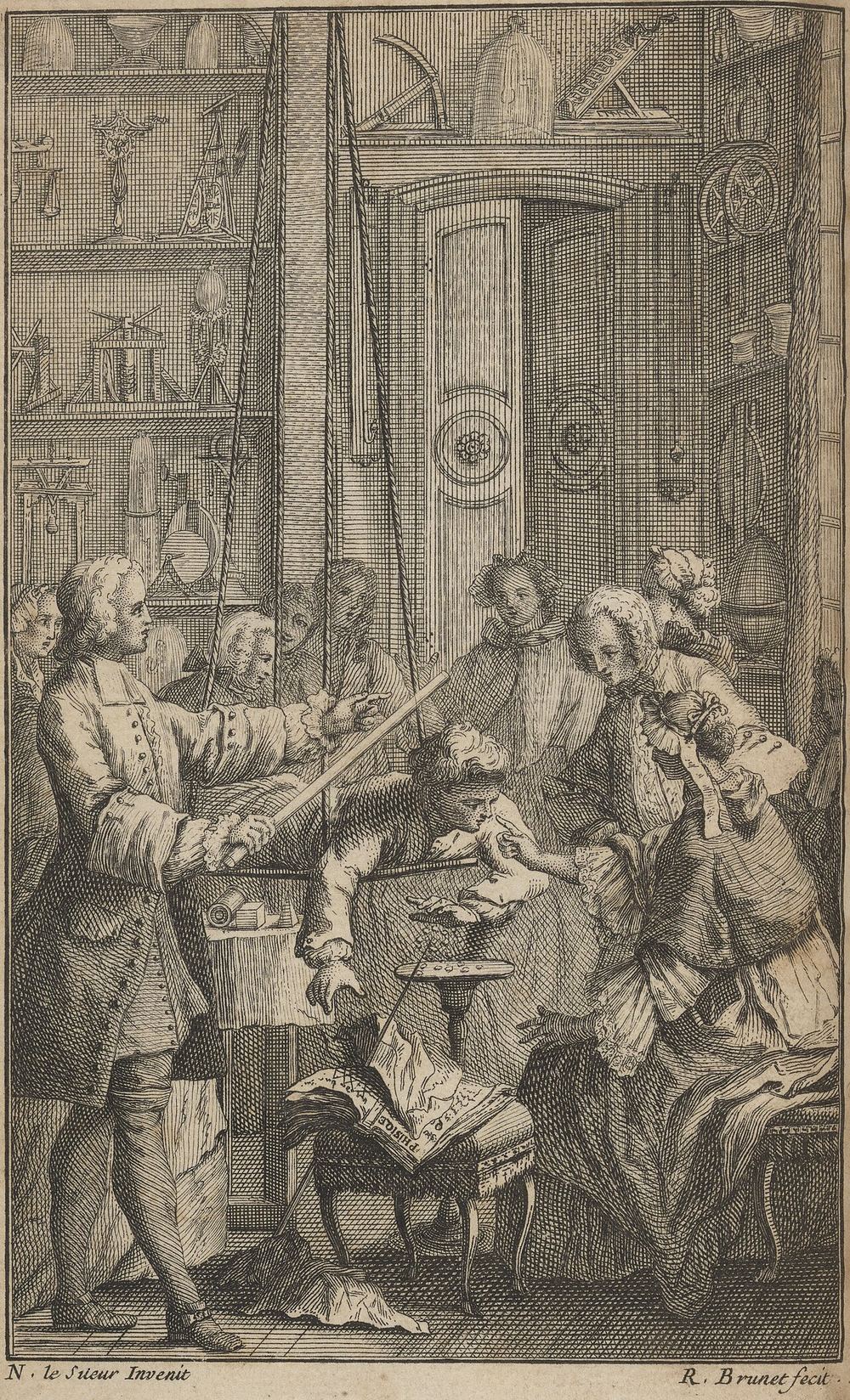
To show it, Gray hangs a boy from silk cords, flat in the air, brings the rubbed tube near his feet, and leaves of metal fly up to his hands and face. The flying boy experiment goes round Europe; in Paris, the abbé Nollet repeats it before society and makes it the picture of his book. The Royal Society gives him its first Copley Medal in 1731.
In Paris, Charles François de Cisternay du Fay takes up Gray’s experiments and puts them in order. In 1733, he shows that nearly anything can be electrified by rubbing, and that anything, metals included, becomes so on contact with an electrified body, provided it is insulated. Then he observes something new: a gold leaf driven off by rubbed glass is drawn to rubbed resin, and the other way round. He concludes that there are two electricities, that of glass, which he calls vitreous, and that of resin, resinous. Two bodies charged with the same kind repel; with opposite kinds, they attract. It is the first time anyone counts the electricities, and these two are the ones lesson 1.1 means when it says "people believe in two electricities".
What remains is the question nobody can answer: what is it that moves along Gray’s string? People speak of virtue, of electric fire, of fluid. The idea of a fluid, weightless and invisible, that rubbing draws out of bodies and the thread carries along, takes hold without anyone ever seeing it. It is convenient, and it explains nearly everything observed.
In 1745 and 1746, two men, Ewald von Kleist in Pomerania and then Pieter van Musschenbroek in Leyden, try to put that fluid in a bottle. A flask, of spirits for one, of water for the other, a nail dipped into it, the hand holding the flask, the nail touched to a machine’s conductor, then a finger brought near the nail. The shock throws the arm back. Musschenbroek writes that he would not do it again for the kingdom of France. The Leyden jar keeps electricity, gives it back all at once, and whole lines of people holding hands are made to jump. The fluid has become something you can store, and something that hurts.
That is where Benjamin Franklin comes in, in 1747, with a glass tube sent from London and a bottomless curiosity. Where Europe counts two electricities, he proposes that there is only one: a single fluid, in surplus in one body and in shortage in the other. He names the surplus "plus" and the shortage "minus", explains the Leyden jar as too much on one side of the glass and too little on the other, and bets that it is the rubbed glass that holds the surplus. What follows, the bet lost a hundred and fifty years later and the arrow never turned round, is the lesson’s story to tell.
What next?
- Lesson 1.1, Charge and its motion. Franklin’s fluid becomes charge, the bet becomes conventional flow, and the electron arrives in 1897.
- History: the Leyden jar. The first capacitor, what Franklin made of it, and the word Volta would give it.
The Leyden jar
If electricity is a fluid, you ought to be able to bottle it.
storyFranklin’s fluid
A multimeter in series shows a number with a sign, and the sign depends on which lead you put on which side.
storyGalvani’s frog
The pack of a cordless drill shows 3.7 V cells.
the crossroads1.1 Charge and its movement
Everything tied to this idea, and the exercises.