Galvani’s frog
The pack of a cordless drill shows 3.7 V cells. Nobody chose that number; it comes from two materials and what lies between them. The first voltage drawn out of matter was seen in the leg of a frog, and taken for life.
The animal’s electricity
Luigi Galvani teaches anatomy at Bologna. In the 1780s he prepares frogs: the lower body alone, the skin removed, the crural nerves laid bare. An assistant touches a nerve with the point of a scalpel while an electrical machine draws a spark, and the leg twitches. Galvani repeats the trial in a thunderstorm, then without storm or machine: frogs hung by a brass hook from the iron railing of his balcony contract when the hook is pressed against the railing. He publishes it in 1791, the De viribus electricitatis in motu musculari commentarius.
His conclusion is plain: the electricity is in the animal. The muscle stores it like a Leyden jar, the nerve conducts it, and the metal arc only closes the circuit. The idea was reasonable. People had known since Walsh, around 1773, that the torpedo ray’s shock is electrical, the jar was barely forty years old, and the jump of a leg looks like the blow it gives. A physician who sees a muscle leap at a spark may believe he holds the fluid of life.
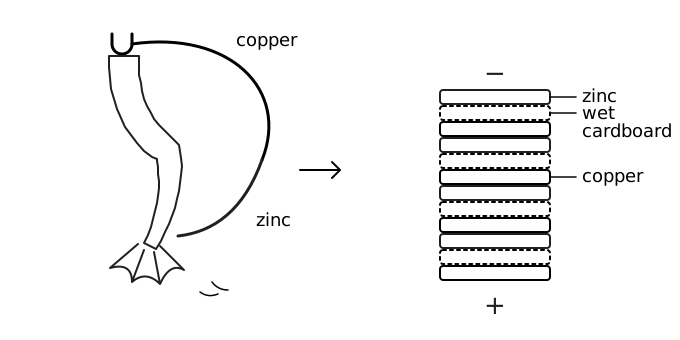
Two metals, and no frog
At Pavia, Alessandro Volta is won over, then notices by 1792 what Galvani had seen without keeping it: an arc of two different metals contracts strongly, one of a single metal little or not at all. The frog is for him only an electrometer; the source is the contact of the metals. He shows it without an animal, by an old trial of Sulzer’s: a strip of tin on the tongue, a silver coin farther back, and as soon as they touch, a sour taste, as long as the contact lasts. Volta ranks the metals and calls electromotive force what drives the fluid at the contact.
Galvani replies in 1794 with a contraction without any metal, the nerve of one leg folded back onto its own muscle, where it is cut. The fact is true; Volta explains it badly. Giovanni Aldini, Galvani’s nephew, takes up the quarrel. Volta stacks a disc of zinc, a disc of silver or copper, a round of cardboard soaked in brine, twenty times, forty times; the column shocks at will, without rubbing or rest. He also lines up cups of salt water joined by arcs of zinc and silver, his crown of cups, and the shocks add up. On March 20, 1800, he describes both in a letter to Joseph Banks, president of the Royal Society, read on June 26 and printed in the Philosophical Transactions.
What became of them
Galvani never saw the pile. He refuses the oath to the Cisalpine Republic, loses his chair and dies in December 1798. Aldini takes galvanism around Europe; in London, in January 1803, he passes the current of a pile through the corpse of George Forster, and the hanged man’s jaw moves. Volta shows his pile at the Institut in Paris in 1801, before Bonaparte; he will be a count, then, in 1881, the volt. Banks circulates the letter before it is read; William Nicholson and Anthony Carlisle build a pile from it. In early May 1800, its two wires dipped in water give hydrogen and oxygen: the water is decomposed. Faraday, in 1834, gives this chemistry its words, with Whewell’s help: electrode, electrolyte, ion.
The cell, as we read it today
Volta was right about the two metals and wrong about the cause. Contact alone gives no lasting current; some material has to be consumed, and in the pile of 1800 it is the zinc. Each atom that goes into the brine as an ion leaves two electrons on the disc; they go off through the wire to the silver, where the hydrogen of the water takes them and makes bubbles. The bubbles insulate the silver and the pile weakens: that is polarization. In the wet cardboard, the ions close the loop the electrons began in the wire; no electron crosses the electrolyte, no ion passes into the metal. That is the complete loop lesson 1.1 has you draw: ions inside, electrons outside.
The voltage comes from there. Each metal in its solution has its electrode potential; the cell gives the difference: about a volt for zinc and copper, 3.7 V between lithium-filled graphite and the oxide facing it in a tool pack. Kuphaldt puts the cell this way: two electrodes, an electrolyte, a potential proper to the pair. Lithium-ion is only another pair, in an electrolyte without water, because water decomposes at little more than a volt; Nicholson and Carlisle saw it come apart first. Putting cells in series is rebuilding the crown of cups.
Galvani was not wrong about everything. The nerve is excitable, and the contraction without metal was a real current, the one that leaks from a cut muscle. Nobili reads it on a galvanometer in 1828 without recognizing it, Matteucci measures it around 1840, du Bois-Reymond follows it from 1843 into the nerve, and a century later the action potential is written down. The living cell keeps across its membrane, by a pump, an imbalance of sodium and potassium, a few tens of millivolts: it is itself a cell run on ions. Galvani had the right idea in the wrong place.
The words that remain
The volt, adopted in 1881 at the Paris congress, measures what Volta tasted on his tongue. Galvani left his name to galvanism, Volta’s word, to the verb galvanize, first to shock a body with the pile, then to rouse a crowd, finally to zinc-coat iron, and to the galvanometer. French kept Volta’s stack, la pile, and says it of a single cell. English kept battery, the word Franklin gave his row of lead-covered panes, then of Leyden jars, which slid onto Volta’s pile. In English the cell is a cell, the stack a pile, the assembly a battery; at the bench, in either language, it is the pack.
What next?
- Lesson 1.1, Charge and its motion. The cell drawn out, ions inside, electrons outside, and the complete loop of a charge.
- The Leyden jar. The first capacitor, the one Galvani compared the muscle to, and Franklin’s battery.
- Lesson 6.2, the pack. The lesson to come opens the tool pack: cells in series, the protection circuit, and what 3.7 V means.
Electricity before Franklin
Before it was something you measure, electricity was a parlour curiosity for two thousand years.
storyThe Leyden jar
If electricity is a fluid, you ought to be able to bottle it.
storyFranklin’s fluid
A multimeter in series shows a number with a sign, and the sign depends on which lead you put on which side.
the crossroads1.1 Charge and its movement
Everything tied to this idea, and the exercises.