Franklin’s fluid
A multimeter in series shows a number with a sign, and the sign depends on which lead you put on which side. Behind that plus or minus stands a man who never saw an electron and who had to decide, around 1747, which of two rubbed bodies had the surplus.
One fluid, too much or too little
Since Du Fay, in 1733, people have known there are two electricities: that of glass and that of resin. Each repels its own kind and attracts the other. In Philadelphia, Benjamin Franklin receives a glass tube from London and starts rubbing. What he sees, he writes to Peter Collinson between 1747 and 1750; printed in London in 1751, those letters will make their way around Europe.
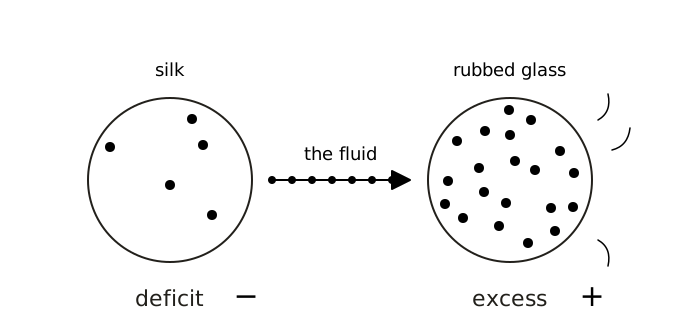
His idea fits in one sentence: a single electrical matter, a fluid spread everywhere, of which every body holds its ordinary share. Rubbing makes nothing; rubbing moves. The rubbed glass takes some from the hand that rubs it; one has too much, the other too little. Franklin says "plus" and "minus", "positive" and "negative". Two bodies with too much repel each other, too much and too little attract, and on contact the fluid runs from the full to the empty. That two shortages also repel each other, Franklin saw without knowing how to say it, and admitted as much. Du Fay’s two electricities were only one, seen from both sides of zero.
It remained to say which had the surplus. Franklin held for the glass. Rubbing, to his eye, pumped the fluid from the hand into the tube, and later he would believe he could read, at the tip of a point, a different glow for each electricity. They were bad reasons, but reasons they were: an informed bet, not a coin toss. For a moment, you have to believe it with him. The fluid goes from plus to minus, like water from a basin too full into another that wants some.
What the idea explained
The idea held because it explained well. The Leyden jar: the inner face of the glass has a surplus equal to the shortage on the outer one, you cannot charge one without stripping the other, and the discharge sets both back to zero. Charge is neither created nor lost, it moves; that is the conservation of charge, still true. Cork balls that spread apart tell you too much or too little, not which, as long as you hold nothing known near them. The lightning rod follows from it: a grounded point should draw the fluid gently out of the cloud. At Marly, in May 1752, an insulated iron rod draws sparks from a storm cloud: the cloud is charged, the point draws it off, Franklin is right on the essential.
Then people build on it. Volta stacks his discs in 1800; Ampère, in 1820, fixes the direction of the current to that of positive electricity, from plus to minus; Ohm writes his law in 1827; Faraday, in 1834, follows the ions in his cells. For a hundred and fifty years, every rule is written with an arrow that asks no one who carries the fluid.
The particle with the wrong sign
In 1897, in Cambridge, J. J. Thomson studies cathode rays, which leave the cathode of a tube emptied of air and make the glass glow where they strike. In a better vacuum than his predecessors had, he bends them with an electric field, then with a magnet, and from that gets their charge-to-mass ratio. Not the charge, not the mass: the ratio of the two, nearly a thousand times the hydrogen ion’s. His "corpuscles" are the same whatever the gas or the metal of the cathode, and they are charged minus. Thomson, at this point, says nothing about the copper wire.
That step, others take. In 1900, Paul Drude proposes that a metal is a gas of free carriers, soon only electrons, among fixed atoms, which conducts both heat and current; a hypothesis that calculates well. In 1916, Richard Tolman and T. Dale Stewart put it to the test: they spin a copper coil, stop it dead, and the carriers keep going on their momentum. A galvanometer sees that inertial current pass: its sign is negative, its charge-to-mass ratio the electron’s. In a wire, what flows goes from minus to plus. Franklin had lost his bet.
Why the arrow did not move
Nothing was changed, and not out of laziness. Current is a quantity with a sign, and minus three to the left is plus three to the right: the same charge crosses the section of the wire each second. Ohm gives the same voltage, Kirchhoff closes the same way, the motor turns the same direction, the resistor heats as much. Kuphaldt, who writes his whole textbook in electron flow, says so himself: a matter of notation, not of physics, and you have to know which one a book has chosen.
The convention has another merit: it takes no side for any carrier. In a cell, positive ions cross the electrolyte in the direction of the arrow while the electrons go by the wire; in a semiconductor, holes go from plus to minus. The arrow on the diode follows the convention. On the bench, the multimeter does as Franklin did: it counts a fluid that enters by the red lead and leaves by the black, and puts a minus in front if it is the other way.
The words that remain
The fluid is gone; its words have stayed. Positive and negative, plus and minus, charging and discharging a body, all of that is Franklin’s. The battery too: he called his row of lead-covered panes, then of Leyden jars, joined like a battery of cannon, an "electrical battery", and the word slid onto Volta’s pile and then onto the pack on the bench. Every time you read a sign on a multimeter, you still speak the language of a man who got the direction wrong and was right about nearly everything else.
What next?
- Lesson 1.1, Charge and its motion. The two arrows on one circuit, conventional flow and electron flow, and the orders of magnitude.
- Electricity before Franklin. From amber to Du Fay, what people saw before counting the electricities.
- The Leyden jar. The first capacitor, what Franklin made of it, and the name Volta would give it.
Electricity before Franklin
Before it was something you measure, electricity was a parlour curiosity for two thousand years.
storyThe Leyden jar
If electricity is a fluid, you ought to be able to bottle it.
storyGalvani’s frog
The pack of a cordless drill shows 3.7 V cells.
the crossroads1.1 Charge and its movement
Everything tied to this idea, and the exercises.