The lesson
1.1 Charge and its movement
Outcome 1 of 9 in domain 1 · Foundations, direct current
What charge is, who carries it in each medium, and why it resists: the step before the quantities.
Understand
In a copper wire, the electrons go from the minus terminal to the plus. On the diagrams, though, the current arrow goes from plus to minus. Both are true. To understand, you have to go back before the electron.
A battery, a switch, a bulb. Close the switch and watch the current run. The moving dots follow the convention, from plus to minus; that is not the way the electrons go, and that is the whole point.
Before Franklin, electricity is an attraction you make by rubbing, told on its own in Electricity before Franklin. Since Du Fay, in 1733, people believe in two electricities, vitreous and resinous. Around 1747, in Philadelphia, Franklin rubs glass and wants only one: a fluid present in all matter, "plus" where it abounds, "minus" where it is short, and flowing from surplus to shortage, from plus to minus. Which of the two held the surplus? He bet on glass; nothing he could measure really settled it.
For a hundred and fifty years, Volta, Ohm, Ampère and Faraday included, everything is built on that. Then in 1897, J. J. Thomson brings to light, in a vacuum tube, the particle that carries charge; over the following years it becomes clear that it is the one moving in metals. Its charge is negative. Franklin had lost his bet.
And nothing was changed. A negative charge heading left equals a positive charge heading right: current is a quantity with a sign, and the same amount of charge crosses each second. The convention takes no carrier’s side, and that is what makes it right.
Conventional flow, from plus to minus, is the one on diagrams and in the symbols (the diode’s arrow, the bipolar transistor’s). Electron flow, from minus to plus, is the one matter follows. Know which one a book has chosen, then stop thinking about it; the calculations do not know.
One ampere, one coulomb per second, is a little over six billion billion electrons, and they creep: a few hundredths of a millimetre per second in a lamp cord. What travels at nearly the speed of light is the push: Kuphaldt’s pipe already full of marbles, one goes in, one drops out, and none of them ran.
The classic mistake: believing one of the two directions is wrong. The only real error: mixing them in a single line of reasoning.
What the source lacks
Lithium. Kuphaldt’s chapter 11 says not a word about it, and his cell is lead-acid. In a pack cell, the lithium ions, positive, go during discharge from the minus electrode to the plus one, in the direction of the arrow; the electrons go the long way round through the tool, the other way.
Holes. Kuphaldt keeps them for his volume III. An empty electron seat, which a neighbour fills and which thereby moves like a positive charge: the only positive carrier you meet in a solid, and it walks in Franklin’s direction.
See
The targets
- Charge, the atom, free electrons. In one page, without a formula: why a metal has free electrons, and what a coulomb is worth.
- Carriers by medium. A four-row table (metal, electrolyte, semiconductor, arc): carrier, sign, direction.
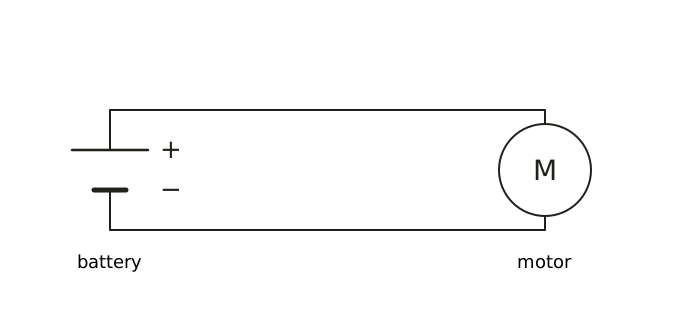
- The two directions. Franklin and Thomson in five sentences, then both arrows on the circuit in the figure, and why the calculation does not change.
- Conduction and resistance at the atomic level. Why a metal resists more when it heats, a semiconductor less.
- The cell. The ions inside, the electrons outside, one charge all the way round.
- Conductor, semiconductor, insulator. Tell them apart by what they offer to charges; then why copper, aluminium and pack-strip nickel, three conductors, do not conduct alike (pure nickel resists four times more than copper).
- Diagnosis. A contact that heats, a battery that stops delivering in the cold: which motion of charges is hindered, and where.
Misconceptions
"Electrons go from plus to minus."
No, that is the conventional arrow; the electrons in a metal go the other way. Socratic 00176 notes it: their direction is not in debate, only its notation is."Electrons travel at the speed of light."
They crawl; only the push is fast (the pipe of marbles)."One of the two conventions is wrong."
Neither, there is nothing to correct: same numbers, each in its place, diagrams or matter.
The word
ElectronÉlectron
From the Greek ēlektron, amber, the resin that, rubbed, attracts straw; Gilbert drew "electric" from it around 1600, and from there "electricity". In 1891, the Irishman George Johnstone Stoney proposes "electron" for the unit of charge, calculated without ever seeing it. Thomson, who finds the particle six years later, says "corpuscle"; Stoney’s word won. The carrier in our wires is thus named after a resin. In French, électron, the same word with an accent.
Read
Kuphaldt, Lessons in Electric Circuits, volume I (DC), chapter 1: Basic concepts of electricity. "Static electricity" tells of Du Fay and Franklin, with wax and wool rather than glass; "Conductors, insulators, and electron flow" is target 1; "Conventional versus electron flow" is target 3, with the diode symbol. Kuphaldt, as he says there, writes everything in electron flow, opposite to most other books.
Targets 4 and 6, metal side: chapter 12, Physics of conductors and insulators, resistivity and temperature. Target 5: chapter 11, Batteries and power systems.
Bridges
- History
- Franklin’s letters, 1747 to 1750, appear in London in 1751; Thomson identifies the electron in 1897, Nobel Prize in 1906, Benjamin Franklin.
- Physics
- The elementary charge, 1.602 × 10⁻¹⁹ coulomb, measured by Millikan from 1909 on, has defined the coulomb since 2019, Elementary charge.
- Chemistry
- "Ion", a word Faraday introduces in 1834, suggested by William Whewell, Greek for "the one that goes": two signs, two directions, Ion.
- Mathematics
- Minus three to the left equals plus three to the right; that is what lets Franklin’s convention outlive the electron, Sign (mathematics)).
What it unlocks
What next?
- 1.2 The quantities. The coulomb and the ampere, units and orders of magnitude, from the Raspberry Pi to the chainsaw.
- 1.3 Ohm’s law and power. Voltage pulls, resistance holds back, and the current whose direction we just settled takes its value.
- History: the Leyden jar. The first capacitor, in 1745, which Franklin explains with his fluid; from that fluid being condensed, Volta will draw the word condensatore in 1782, still the French word for a capacitor.