The lesson
6.2 The pack
Outcome 2 of 8 in domain 6 · Power, panels, packs, motors, converters
Series and parallel, balancing, BMS, spot welding, casing, rebuilding a tool pack.
Understand
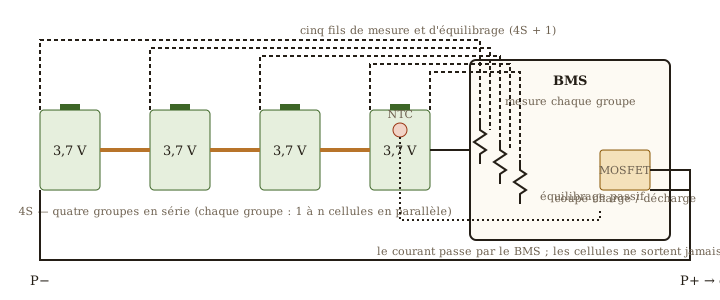
A pack is not a big battery: it is a small society of cells, each 3 to 4 V and a few ampere-hours, assembled in series for voltage and in parallel for capacity. The designation says it all: a "10S3P" pack has ten series groups of three parallel cells, thirty cells, 36 V nominal and three times one cell’s capacity. Reading that code is already knowing how to open a tool pack without surprise.
The trouble with series cells is that they do not stay equal. A slightly weaker cell empties first and fills first; unwatched, it would end up under-voltage on discharge and over-voltage on charge, and it is the one that would kill the pack. Hence the BMS, the management circuit: it measures each group, cuts when a single one leaves its range, watches temperature and current, and balances, most often by gently bleeding the fuller groups into a resistor during charging.
What a BMS datasheet hides under "30 A": the continuous current it tolerates and the cutoff current are two numbers, and a motor tool asks for peaks well above its average. And what assembly demands: matched cells, same capacity and internal resistance, or the weakest group makes the law; nickel strips spot-welded, their thickness chosen for the current; and protections you do not see, insulators, holders, cell fuses, thermistors. A commercial pack has so many because each was paid for by a fire somewhere.
What the source lacks
The tool pack itself. An EGO 56 V is a 14S, a Stihl AP or a Makita 18 V a 5S, in 18650 or 21700 depending on capacity. The contacts beyond + and − carry the thermistor, and often a data line through which tool and charger query the pack; that is what sometimes makes a rebuilt pack invisible to the original charger. Opening one means first photographing the wiring and noting where each BMS sense wire goes, because a balance lead plugged in the wrong order destroys the BMS within the second.
See
The targets
- Read 10S3P — calculate voltage and capacity, and find the structure in an opened pack: count the groups, follow the nickel strips.
- Imbalance — explain where it comes from and what passive balancing does; measure the groups of a used pack and find the weak one.
- What the BMS protects — read a datasheet: thresholds, continuous current, cutoff current, temperature; say what a cheap BMS lacks.
- Matching — measure capacity, internal resistance and voltage of ten cells, and form the groups.
- Spot welding — 0.15 mm strips for a small pack, 0.2 or doubled for a saw pack; pull on the weld, it must tear the nickel before letting go.
- Rebuild a tool pack — the outcome’s project: disassemble, record, replace, reassemble, test under real load.
- Protections — name those of a commercial pack and say which one you could not reproduce.
- Diagnosis: the pack that cuts mid-cut — group voltages under load: the one that dives is the weak one.
Read
There is no Kuphaldt chapter for this: his textbook predates lithium. The useful sources are elsewhere: the datasheet of an 18650 cell (Samsung 25R, Molicel P28A), the datasheet of a commercial BMS (JBD, Daly), and Cadex’s Battery University, BU-302: Series and Parallel Battery Configurations, readable and honest. For spot welding, the forums (Endless Sphere) beat the books.
Bridges
- Chemistry
- A cell is a redox reaction kept on a leash: what oxidizes, what reduces, and why each chemistry has its voltage, Lithium-ion battery.
- Physics
- A pack’s energy in watt-hours against the physicist’s joules, and what 500 Wh amounts to as a falling mass, Watt-hour.
- History
- Volta’s pile, in 1800, is already a pack: cells in series, and the French word for battery, « pile », comes from the stacking, Voltaic pile.
- Mathematics
- S × P: the same total capacity can be built several ways, and each gives another voltage and another possible current; a small piece of combinatorics done in pencil.